Tuesday, November 24, 2020: Via Zoom, Kristen will be delivering the presentation Digging Up Stories for the Wellington County Branch of the Ontario Genealogical Society. Start time 7 p.m. From the branch’s website:
“Join us as Kristen den Hartog explores the fascinating resources she and her sister/co-author Tracy Kasaboski used to create The Cowkeeper’s Wish: A Genealogical Journey. The book begins in the slums of Victorian London and follows the authors’ family for nearly a century, ending in London, Ontario, in the 1930s. Kristen will give specific examples of where they found ancestors ‘wandering insane,’ charged with crimes, dying in workhouses, and fighting in the First World War. She’ll also discuss the family archive, and talk about how personal resources were useful for building both The Cowkeeper’s Wish and the sisters’ first collaboration, The Occupied Garden, which chronicles the lives of their father’s family in the Netherlands in WW2.”
The meeting is open to the public but guests will need to register ahead of time. Please see the link above for more details.
Wingham, Ontario, around 1910, courtesy McCord Museum
I’ve mentioned before that I’m currently working on a new book about WW1 soldiers and medical staff returning to Canada after the war. The book is non-fiction, though not family-related this time, however the research chops Tracy and I acquired writing The Cowkeeper’s Wish have come in extremely handy for this new project. Sometimes the stories are so fascinating I go down rabbit holes and disappear for great lengths of time.
So it went when I came across an article about a man named Hugh Russell. I was on a mission to find out more about shell shock — what we would now call PTSD — and how men grappled with it for years after the war was over. In a newspaper archive, I found a 1937 article about a veteran having gone missing from the farm he was working on near Wingham, Ontario. The Windsor Star reported:
Fear that Hugh Russell, 42-year-old farmhand and returned soldier, is lost in a treacherous swamp in what is known here as the Alps, is being entertained here today. Russell was said to have been acting strangely when he disappeared from the home of his employer, Nelson Pickells, Sunday night, and when he did not return to his work yesterday morning, a search of the swamp in the vicinity of the Pickells farm showed he had slept in the swamp overnight. It is feared he may be suffering a recurrence of shell shock. The farm is on the Alps in the Township of Culross, in a district where there is particularly treacherous land with many morasses and bog holes. Russell, a former Barnardo Home boy, and said to have suffered shell shock during the war, came to work for Nelson Pickells last Christmas. He ate his dinner on Sunday night but, it is reported, acted in a strange manner and without any comment left after the meal for the swamp. The Pickells believed he was suffering melancholia, and did not worry until he failed to return. He is about five feet six inches tall, has jet black hair, a swarthy complexion, and is very thin. When he disappeared he was wearing a white helmet, dark overalls, a dark blue shirt and horn-rimmed spectacles.
The article made me curious to know more about Hugh Russell — his childhood as a “Barnardo boy,” his war experience, what treatment he might have had for shell shock, and how he’d reintegrated into society after the war. Of course I also wanted to know if he made it out of the swamp! So I started digging, and was quite amazed by the amount and the variety of material I found, sometimes with the help of strangers with a shared curiosity, sometimes from creative and persistent searching. Each piece fitted into another piece and added context to what was already there. I could write a whole series of posts explaining how these pieces emerged in a non-linear way, and how the genealogical sleuthing unfolded. But Hugh’s story is so touching that I think I’ll just tell it as I know it now, in chronological order.
Though his service record says he was born in March of 1895, Hugh Willis (elsewhere William) Russell was actually born on September 27, 1894, in Belfast, so perhaps he didn’t know his birthday. He was the eldest child of Thomas John Russell, a coppersmith, and Sarah Neeson, a weaver, who’d been married a year earlier. A few years later, they had a daughter, Ethel Baker Russell. The family lived at various addresses in Belfast in the 1890s, but by 1899, they’d moved to Birkenhead, Cheshire, a seaport town that looks across the River Mersey to Liverpool. There, a son named Robert George was born. The baptism record shows that Thomas was still a copper/tinsmith, as does the 1901 census record, which puts the family on Back St. Anne Street.
Encyclopaedia Britannica map, 1900
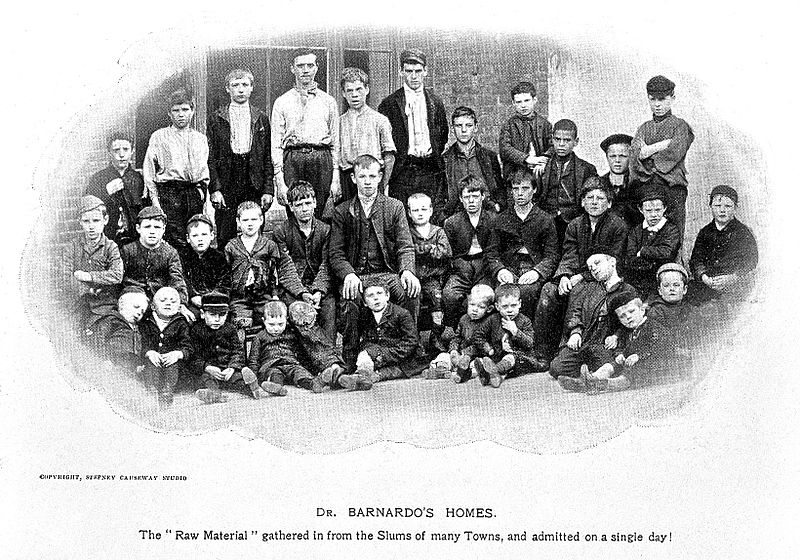
I’m still not certain what happened to Thomas and Sarah (though I have plenty of hunches!), but by 1906, Hugh was on his way to Canada in the care of Barnardo’s. Thomas John Barnardo was the founder and director of homes that took in poor children, beginning in the 1860s. For a glimpse of his philosophy, see his own book, Something Attempted, Something Done!
A group of “miserable street lads,” or what Barnardo called “the raw material,” from Something Attempted, Something Done!
For those unfamiliar with the home child scheme in general, Library and Archives Canada puts it this way:
Between 1869 and the late 1930s, over 100,000 juvenile migrants were sent to Canada from the British Isles during the child emigration movement. Motivated by social and economic forces, churches and philanthropic organizations sent orphaned, abandoned and pauper children to Canada. Many believed that these children would have a better chance for a healthy, moral life in rural Canada, where families welcomed them as a source of cheap farm labour and domestic help.
After arriving by ship, the children were sent to distributing and receiving homes, such as Fairknowe in Brockville, and then sent on to farmers in the area. Although many of the children were poorly treated and abused, others experienced a better life and job opportunities here than if they had remained in the urban slums of England. Many served with the Canadian and British Forces during both World Wars.
In the LAC’s Home Children database, I found Hugh, age 11, arriving on board the Dominion with 240 other children heading to uncertain futures in a foreign land. Many home children had horrible experiences. Even those who weren’t mistreated must have been devastated to leave their families at such a young age. As I mentioned in another post about a home child, many of these young men were among the first to enlist in WW1, in the hopes that they could get back to England to see their families again. (In 1908, Hugh’s sister Ethel arrived and was placed with a family in Orangeville; and in 1912, Robert came too, and went to Bolton. Like their brother, they’d come with the Barnardo’s organization. Why, and whether there were other children, I’m still not sure.)
From the Wellcome Library
Hugh was placed in Wingham, Ontario, with farmer James Wray and his wife, Martha, who had a little boy named Graham. James Wray kept horses, and it seems that Hugh developed a great love for them over the years. In various places, his service record labels him a horse trainer, trader and jockey. When he enlisted with the 18th Battalion in London in February 1915, he was still living with the Wrays. Graham would have been about 12 by then, and would not have remembered a time when Hugh wasn’t part of the household. Hugh’s service record describes him as 5’3″, fair-skinned, with blue eyes and dark brown hair. He had no distinctive marks or tattoos, and described his trade as “farmer.”
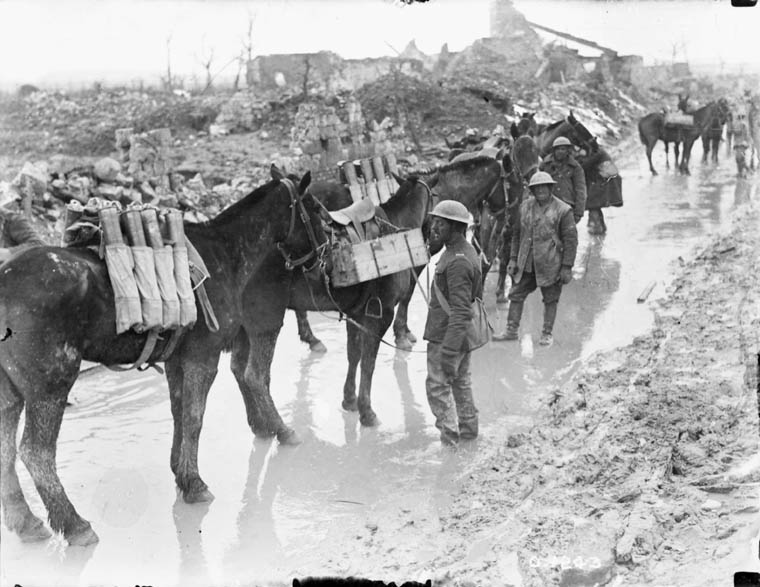
By April of 1915 he was on board the SS Grampian, heading back across the ocean, nine years after his arrival with Barnardo’s. He would have heard news, around this time, of the Battle of Ypres, and the Germans’ first use of poison gas to attack the enemy. Soon, gas masks were part of a soldier’s essential equipment, and a horse’s too.
Library and Archives Canada, PA-005001
A little of what Hugh experienced on the Western Front comes through in his letters home to Graham, which were occasionally published in the Wingham Advance. On January 2, 1916, from “Somewhere in Belgium,” he wrote:
Dear Graham … Well, it is still raining and the mud is getting deeper, I would much rather have the snow. It is certainly miserable with your feet wet all the time and we are all the time scraping off mud. But there is a good time coming and so we are trying to be cheerful until it comes. I don’t believe we will have another winter out here, I think there will be something doing in the spring. You see we can’t do much as there is so much mud and water. I am in the machine gun section now so I will likely have a chance to kill lots of Germans.
I suppose you had as merry a Christmas as ever, we were in the trenches that day, there was no firing and everything was quiet. We invited the Germans over to dinner, some of them started out but got scared before they got far and beat it back. We can [call out] to them and hear them answer but we can’t understand them. I think they are Prussians in front of us. They pump the water out of their trenches and it runs down into ours, so we have to keep pumping all the time. We have a bit time with the rats in this country they seem to be here in millions. They are all sizes and colours, sometimes when they jump up on the parapet they startle us for they look like a man coming over. They are very tame and we have to kick them out of the way, they often eat our rations and keep scratching and running about when we are trying to get to sleep and I guess they bother the Germans just the same.
This is a great life. After this I will be able to live back in the bush in a hole in the ground, I’ll hardly feel comfortable in a feather bed. I just get my clothes off every eighteen days that is to get a bath. Still we don’t mind it much and we have many a good laugh, you would think if you heard us sometimes that there was no war on at all. I don’t believe I could stay away from the boys very long now, we are so attached to each other although the old battalion is gradually changing into a different lot of faces. The half of them seem to be strangers to me now.
Well I guess when this is all this time. When you write again send my letter to machine gun section instead of B company. Hoping this year will see us all together again, I remain your old friend.
Hugh
The tone of Hugh’s letters changed as the months went on, and by September 1916, during the Battle of the Somme, Hugh was in no condition to write. But I’ll save that part of the story for next time, exploring Hugh’s war experience in more detail, as well as his love for horses, and his treatment in England for shell shock.
❤
With thanks to the London & Middlesex Branch of Ontario Ancestors’ facebook group, and in particular the tenacity of Cookie Foster. Appreciation also for the Huron County Museum’s wonderful collection of digitized newspapers, and Eric Edwards’ tireless 18th Battalion research. And with special thanks to Wray family descendants.
A 1913 sliver of what is now the Junction Triangle neighbourhood in Toronto’s west end. The image comes from Goad’s Fire Insurance Plan. Click here for a larger view.
Last year at this time, I posted about James Morley’s wonderful mapping project, A Street Near You, and how I used the map to find out about men with connections to my own street, Perth Avenue in Toronto, who’d died in the First World War. Remembrance Day has rolled around again, but what a different world we find ourselves in. COVID-19 means that my house is busy during the day, whereas before I had it gloriously to myself to work away on my writing. But it also means that my friends work from home, and I’ve developed a nice routine with one of them, walking most lunchtimes.
My friend and I thought we might extend our walk for Remembrance Day, and visit Prospect Cemetery, but because of COVID, the cemetery has asked that the public stay away, so instead we’ve turned to A Street Near You, and will walk by a few of these addresses to acknowledge the people who once lived there.
A little icon on the map tells me that Stanley Arthur Price lived at 346 Wallace Avenue, between Perth Avenue and the West Toronto Railpath, and died on November 10, 1917. A quick google of his name shows that the map should actually hold two icons at that same address: Stanley’s brother, Jack, was killed in action in May of the same year.
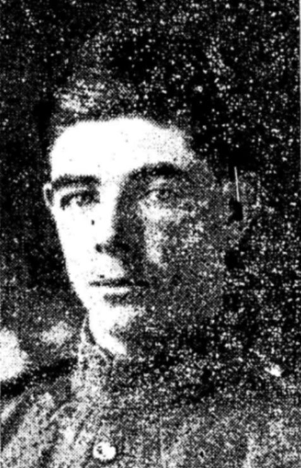
When Jack died, the Toronto Star ran a picture of him, and an article that said, “He was 27 years old, and employed with the Canadian Kodak Co. He enlisted with his brother, Pte. Stanley Price, who went overseas with the same battalion, and is now on the reserve in England after getting trench fever in France. Pte. Jack Price was at one time a conductor on the Toronto Street Railway Co. Besides his father and mother, he leaves a 16-year-old brother, Charles, and an older brother, William, who has been rejected several times as unfit for service in the ranks. The family came from London, England, ten years ago.”
According to Stanley’s record, he too worked for Kodak, and was a tinsmith by trade. He recovered from his bout of trench fever, and returned to fighting shortly after Jack died. By November, he was engaged in the Battle of Passchendaele. His death must have been a horrible blow for the family, having already lost one son — and his service record suggests additional anguish: Stanley was reported “wounded and missing” in November, and the amended status “killed in action” came almost a year later. Many families held out hope that a man labeled “missing” would eventually return.
A Street Near You says that Frank Hamilton Fish lived a few doors west of Stanley and Jack Price, at 358 Wallace, and that he died in France in April 1918, just 19 years old. But once again, a bit of snooping reveals even greater losses. On May 10, 1918, an article headed “Second Son Killed” appeared in the Toronto Evening Telegram:
“Word has reached his mother … that her son, Pte. Frank Fish, 709466, died of wounds April 24, in No. 6 Field Ambulance Depot. He was nineteen years of age and enlisted in St. John three years ago with his two brothers. Sergt. Fred Fish was killed July 23, 1917. The third, Pte. Harry Fish, served twenty-six months and was invalided home.” The article goes on to say that the boys’ father had died a year earlier, and their sister’s husband was wounded the day Frank was killed.
Did the Fish and Price families know each other? What was it like for communities like ours to deal with such horrible losses?
A map icon for John William Smith sits at 31 Macaulay Avenue, a block north of Wallace. Smith was older than the Price and Fish sons — a 42-year-old husband and father, listed as a decorator in his record. At the time of his death, four brothers were serving in the army, as well as a son. He had a baby daughter who he’d never met, and a bit of genealogical sleuthing turns up a photograph of her that was apparently in the pocket of his uniform when he was killed in action in November 1917.
James Edward Webster was a “press operator in can factory” when he enlisted in 1916. He was married and had two little boys at that time. The family was living on King Street and only later moved to 71 Edwin Avenue. He first fell sick at Vimy Ridge, where doctors decided he had pneumonia caused by exposure to cold and dampness. “Took cold in the head in December 1916,” his record reports, “with slight hacking cough and pain in the chest. Stayed in the trenches two weeks before reporting sick.” Later it became clear he had pulmonary tuberculosis, and he was invalided home. A 1918 letter from the Mountain Sanatorium in Hamilton is included in his file, and after almost nine months of treatment there tells us that, “His condition has assumed a chronic, stationary type, with temperature normal, moist sounds and sputum cleared up, probably as much as they will ever be. He will get along as well at home, living carefully, as in a Sanatorium. … His lung tissue is so much impaired that he will always be totally disabled from earning a living in the general labour market.” He died in Aurora in January 1920.
A little north and east of the Edwin address is a short street called Hugo Avenue. When my daughter was little, it always seemed that Hugo had extra spirit, and was splendidly decorated at Christmas and Halloween. What it was like 100 years ago, I don’t know, but the map suggests George Gladman had some connection to 2 Hugo, and that he died in France in September 1918. His record says that when he enlisted in 1916, he was a 29-year-old munition worker with young children and a wife named Kate. Like John William Smith, at the time of his death he had a child he’d never seen. When George died, Kate was on her own with four young children. But by 1921, the census shows her at Hugo, remarried and with a fifth child. The words “deaf mute” are scrawled beside her name. Kate’s new husband Ernest Buxton also served in the war. He suffered severe burns from mustard gas in 1917. When he died in the 1940s, the family was still living on Hugo.
These are just a few WW1 stories from addresses between my house and my friend’s, and a tiny selection of the families who lived in our community a century ago.
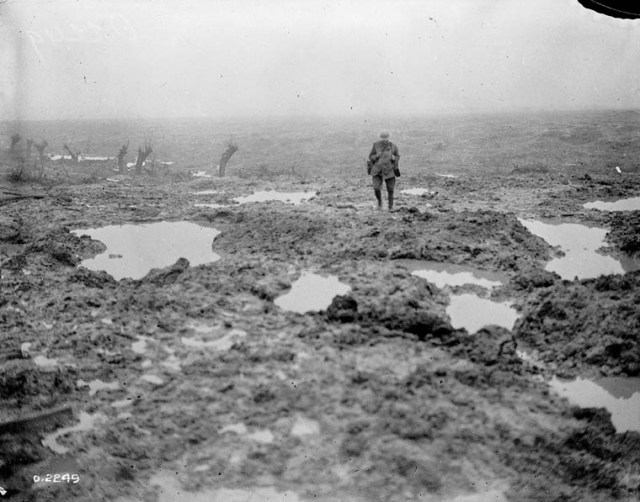
A lone Canadian soldier navigates the mud-soaked battlefield at Passchendaele, Belgium, in November 1917. William Rider-Rider / Department of National Defence / Library and Archives Canada / PA-002165
Early in the pandemic, my husband and I bought a car. We live in Toronto, close to all forms of transit, and have never felt the need to have one. For reasons unrelated to COVID-19, we finally purchased. We wanted to get out to the country more often and explore the possibility of living there, and our daughter has reached driving age, so it all seemed to make good sense.
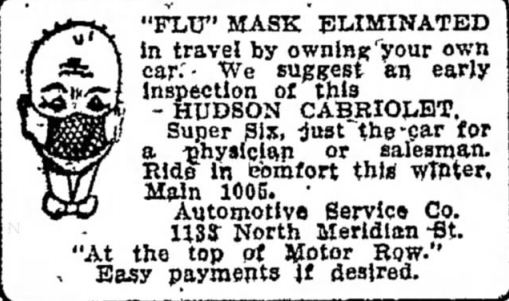
The man we purchased from told us business had been booming. He said people were buying simply because they didn’t want to take transit anymore. We were stunned. It seems the trend has continued to grow. Months later, my husband was recently at the dealership again and there were no cars on view. He asked the fellow there why that was, and he answered that they couldn’t keep them in stock. So when I stumbled on this little ad from a 1918 newspaper, it struck me as yet another parallel between COVID-19 and the Spanish flu.
Indianapolis Star, 24 November 1918
One thing always leads to another when snooping around in a newspaper archive. This article from around the same time reports on “Washington Society Women Working Day and Night as Emergency Chauffeurs.”
Washington Times, Oct 28, 1918
If the worst comes to the worst and they need a job in a hurry, more than a hundred of Washington’s most prominent women can qualify as first-class chauffeurs.
Volunteering their cars and their own services as drivers at the beginning of the Spanish influenza epidemic, they have been on duty both night and day driving doctors and nurses to the homes of influenza sufferers, carrying hot food from relief stations and performing all sorts of errands to speed up the work of all the various organizations engaged in fighting influenza.
So far their batting average is somewhere around 1,000. They have demonstrated that they are afraid of nothing, from influenza germs to flat tires, and after more than two weeks of “chauffing” experience, they can drive to any city address … without ever deigning to consult a city street directory.
These women … report each day at the Webster School, Tenth and H streets northwest. Some work all day, some several hours, others work in emergency.
At the school they wait for a job in much the same fashion as a taxi driver reports to his headquarters. One assignment may be to rush a doctor to a dying patient, another to take a nurse to a “case.”
Some drivers are exclusively for taking food to patients. They report to the school fill up their car with thermos bottles containing bouillon, milk or liquid nourishment, and proceed to distribute the bottles to a list of addresses with which they are furnished. This work necessitates going into the homes of influenza sufferers. Many war workers living in boarding and rooming houses with no one to care for them, not sufficiently ill to be removed to a hospital, are fed three times a day in this manner. …
Demonstration at the Red Cross Emergency Ambulance Station in Washington, D.C., during the influenza pandemic of 1918. Library of Congress
And finally here’s another transit-related find from Toronto around the same time:
Toronto Star, 21 Feb, 1920
(By the way, we still take transit! We wear our masks and use our sanitizer and keep our distance.)
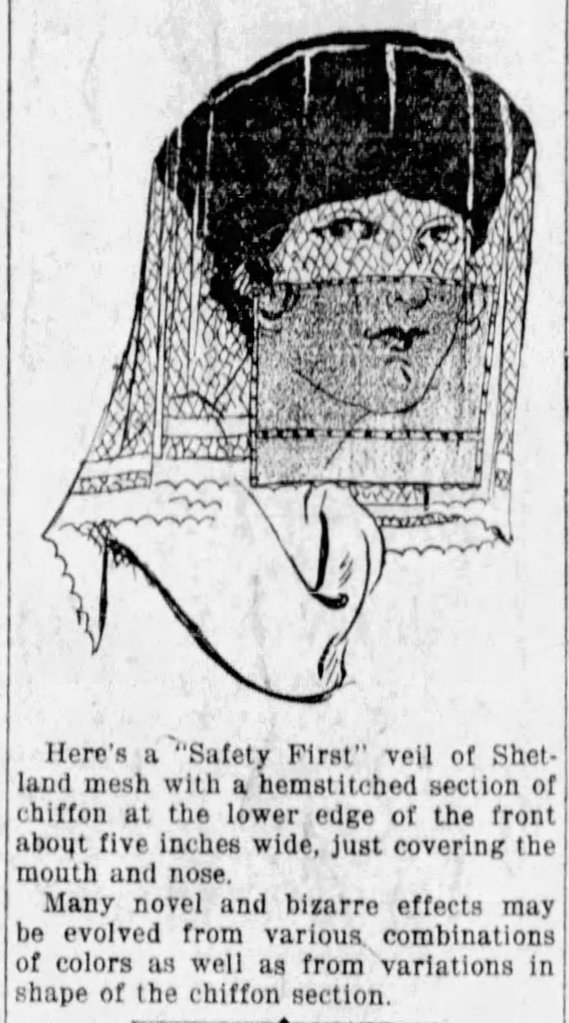
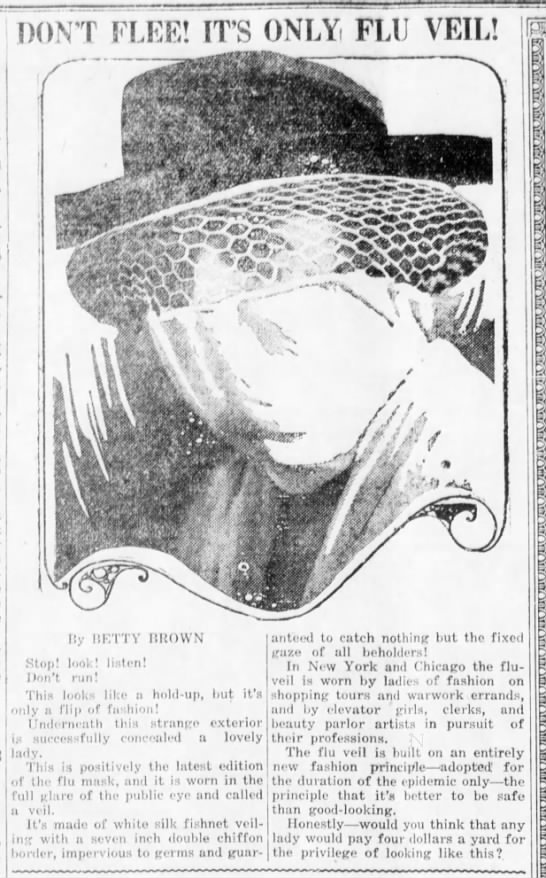
It’s been too long since we’ve posted, so here’s a tiny update in keeping with our current thread on COVID-19 and the Spanish Flu. These ads and articles come from 1918 newspapers that show a trend of wearing “flu veils” and masks to stave off influenza. It’s interesting to see the different takes on beauty! One piece notes, “It’s better to be safe than good-looking,” and another finds the flu veils “bewitching” and “delightful.”
Judging from the following poem, which appeared in the Ogden Standard in December 1918, it would seem the anti-mask movement rankled in much the same way it does today:
“If you think you have the Flu—wear a mask; though some fuss it puts you to—wear a mask; YOU may not believe it’s right—cuss about it day and night—keep your faith and conscience bright—wear a mask! If you think that you’re quite well—wear a mask; wiser heads than yours can’t tell—wear a mask; snare that ‘bug’ before he bites, interrupt his fatal flights, thus you’re spared some awful nights—wear a mask! If you think you know it all—wear a mask; if you think your thinks are small—wear a mask; You would fight for Uncle Sam? Then for him give Flu a lam. If you’re worth a tinker’s damn—wear a mask! Though you swear and sweat and rave—wear a mask; some dear neighbor you may save by that task; doctors say—and they should know—that masks will make this fluzzy go, then do your part or shame will show through your mask! This ONE lesson you should learn—WEAR A MASK; though your mouth and nostrils burn—wear a mask; it’s a shame when you or I let this SIMPLE thing go by, then weep and wail when loved ones die—wear a mask!” –Mace Walton
Sources:
Kansas City Star, Los Angeles Record, Leader-Post, Daily Province, Ogden Standard
A little dip back in time to see how the influenza pandemic was being characterized in the papers over a century ago. The article comes from the Sheffield Daily Telegraph, October 19, 1918, and the photograph from The Sketch a year later.
♦
From The Sketch, Oct. 29, 1919: “This photograph of Miss Isobel Elsom is her latest portrait. Her admirers, however, need not feel any anxiety as to the wisdom of her taking the sea-breezes in summer-kit just as the influenza weather is starting as Miss Elsom wasn’t really posed on the white cliffs of England, but in a studio! The photograph is an excellent example of the effects which can be obtained by the new Elwin Neame method of indoor photography, by which you can be taken ‘anywhere you like’ and yet in the studio.”
THE INFLUENZA SCOURGE. We are told that the best way to guard against influenza is not to worry about it. It is sensible advice, although probably it will have little effect, for the people who are given to worrying over what may happen to them will go on worrying. The people who will follow the advice will be those who would have done so in any case. It would be idle, of course, to try and soothe popular fears by minimising the severity of the epidemic. The whole world is in its grip, and not only is it widespread, but its form is often most virulent. In Sheffield last week, for instance, the number of deaths from influenza and pneumonia reached 300, and all over the country the mortality has been high. There is thus far no sign of any abatement of the scourge, and there are no measures known to medical science that can prevent its running its course. The only useful precautions are those that the individual can practise himself—living as healthily as possible both in mind and body, taking plenty of fresh air, food, and sleep, and keeping out of crowds. If, despite this, he gets it, let him go to bed at once; it is not a complaint that tolerates obstinate heroics. This world outbreak has completely mystified the medical profession. There have been similar pandemics but a writer in The Times is of the opinion that there has been none of these proportions since the Middle Ages. It has swept over the earth like a cyclone, and the causes of its spread are unknown. It is not to be ascribed to the war, although it is possible that its effect has been more pronounced on account of conditions that the war has produced. We do not know that there is even sound evidence of that, for in this country the national health was never so good, and although the sanitary conditions are worse through shortage of labour, that can scarcely apply to the United States where the epidemic is as bad as here. Perhaps the mental state of the people, which has been abnormal for over four years, may have lessened the resistive power, and provided a favourable reproductive nest for the disease germs. But the phenomena of the disease remain baffling, and call for profound and lengthy scientific study that has not hitherto been given to them. We have passed beyond the time when any intelligent mind would see in this world affliction a visitation from God for fighting a war in defence of our liberties. Pandemics are mysteries only because they have never been thoroughly investigated. We may be sure there are definite physical causes for them, and that it is not beyond the brain of man to trace them. The last thing we must do is to give way to superstitious fears.
Oddly, it seems to me, the world has gone mad for toilet paper. Almost as soon as schools and businesses began to close in reaction to the threat of Covid-19, and “social distancing” became a familiar term and practice, toilet paper disappeared from store shelves. I don’t know why that happened; I assume there are people somewhere who have reams of the stuff in their basements, secure in the knowledge that no matter what Armageddon might come, they at least will be able to wipe their bums.
We’re into the fourth week of this strange new reality, and there is still no toilet paper on the shelves of the grocery store in the small town where I live. Of course I don’t go there every day, so it’s possible stock came in, and it was all purchased by the time I again visited. And before the kind souls out there offer to drop a roll at my house, thank you, I’m alright; I found some at my local pharmacy. But the odd practice of hoarding something like toilet paper got me thinking about the product we so take for granted. Everyone jokes about people way back when using pages of the Eaton’s catalog – or the Sears Roebuck catalog, if you’re American – so I wondered, when did the toilet paper we know and love today become a staple of our world?
The now defunct Eaton’s catalog. No longer a choice for bathroom use.
Paper, of course, was invented by the ever-innovative Chinese, and there are various references to its use in tidying up the nether regions. The earliest of these is accredited to a Chinese scholar named Yan Zhitui who wrote in 589 AD, “Paper on which there are quotations or commentaries from Five Classics [of Confucianism] or the names of sages, I dare not use for toilet purposes.” Zhu Yuanzhang, founder of the Ming Dynasty and a brutal tyrant who ruled as Emperor Hongwu in the 14th century, requisitioned many thousands of sheets of scented, extra-soft toilet paper with which to pamper his backside.
The rest of the world, for the most part, made use of whatever was at hand: leaves, hay, moss, even seashells, stones, or snow, depending on location and season. Eventually, paper came into widespread use as a bum wipe for more than just the Chinese, although not until sometime in the 18th century with the ready availability of broadsheets, cheap novels and news flyers. This frugal re-purposing continued to be the method of choice for cleaning the bottom well into the next century.
A quick google will tell you that the toilet paper we’re familiar with, or at least similar to what we use today (when we can find it), was invented by an American, Joseph C. Gayetty, in the late 1850s, and certainly you can find advertisements for his “medicated paper” in the newspapers of the time.
Joseph Gayetty’s Medicated Paper: “One of the best and greatest discoveries of the age.”
In fact, Gayetty was so confident in his “discovery” that he paid for his ad to be repeated down one complete column of the New York Times – twenty-one little boxes all asserting that “its merits as a household’s, traveler’s, and cleanly person’s comfort are making it popular everywhere.” Even better than that, Gayetty claimed, it was a “sure cure for Piles, and also guarantees the healthy who may use it against any touch of that afflictive and torturing disease.” Gayetty bet his bottom dollar on the product, and even watermarked his name onto every sheet.
Gayetty, obviously, was going for more than the cleanliness angle, perhaps reasoning that if not everyone was worried about the fastidiousness of their posterior, they surely cared about their health. His paper, he asserted, manufactured from a buff-coloured fibre known as Manila hemp and treated with aloe as a lubricant, would not only relieve but prevent hemorrhoids – “this distressing complaint” – and as an added bonus it dissolved in water, and would not “choke the water pipe.” While plumbers and homeowners might have been pleased with both features, Gayetty’s medical claims for his paper drew the skepticism of the scientific community of the day.
There were plenty of dubious curative products in the 19th century, and the learned gentlemen writing in journals like The Medical and Surgical Reporter in the United States and Britain’s The Lancet poo-poo’d what they termed Gayetty’s “quackery.” The Lancet called Gayetty’s claim of a curative property an “absurdity,” and noted, mockingly, that “it might be of use to the surgeons who take the rectal region under their care to know that the prognosis, pathology, and therapeutics of this malady are simplified in an uncommon degree, and that their occupation is now gone to the Walls.” The Medical and Surgical Reporter, similarly poking fun at Gayetty’s invention, wrote that “Empirism has changed tactics. Its usual bold effrontery is turned to attack the public in the rear. Mr. Gayetty of New York intends to take advantage of them by catching them with their breeches down, and bring them to the stern necessity of buying his “medicated paper for the water closet.”” And if that wasn’t enough ridicule, the Reporter included a delicious quote from The New Orleans Medical and Hospital Gazette, suggesting that poor Mr. Gayetty “not only place his autograph on each sheet of his invaluable paper … but that he furnish his millions of patrons with his photograph, in like manner. … We are really anxious to see the face of the man who is going to eclipse even homeopathy in the inestimable benefits he thus rubs into mankind; and then, again, it would be such a capital idea to be thus cheering up the sufferer by smiling on the very seat of his troubles.”
One wonders how Mr. Gayetty could hold his head up in public, as the butt of such ridicule. Yet his papers remained for sale in their tidy little packets, bought, used and subsequently flushed, until the 1920s. In the meantime, others had moved into the toilet paper market, although most companies focused on the wipes as an aid to hygiene rather than as curative marvels.
Lion and Mouser toilet paper. Not likely “kitten soft.”
Before long, Mr. Gayetty’s boastful ads were joined by others touting the unmedicated sister product, plain old toilet paper (or the more delicate bathroom tissue), with names like Lion and Mouser – presumably they were “kitten soft”. Each manufacturer took a slightly different approach to selling the product, but most seemed to agree with the buying public that toilet paper fell within the realm of the unmentionable. Customers sidled up to the druggist’s counter and asked for the paper on the sly, and the druggist, complicit, surreptitiously slid the bum wad from its shelf out of sight below the counter and into a bag as if it were poop itself.
By the time ScotTissue ads appeared suggesting that customers need only murmur the brand name to their shopkeeper to have their nether-wipe wishes understood, toilet paper had undergone a transformation. People had choices. One could purchase one’s TP as a packet of stacked sheets, often with handy wire attached that allowed for hanging within easy reach of the loo, or as a single long strand, conveniently perforated to allow for easy tear-off of the required amount, and all spun tidily onto a cardboard roll. TheBrooklyn Daily Eagle’s January, 1895 edition ran a full page advertisement for the “sterling” department store Abraham and Straus listing its many products for those of impeccable taste: Alaska Sable full Circular Capes and Japanese Silk Piano Draperies, as well as “The Regent” toilet paper in roll form and “The Brooklyn” in sheets. Toilet paper had finally come out of the water closet, or perhaps in from the outhouse.
Quilted Northern with the claim to be 100% splinter free. That’d be my choice!
It would seem that a new age had begun, and yet, there was room for improvement. It wasn’t until 1935 that the Northern Tissue Company of Green Bay, Wisconsin advertised quilted toilet paper, but even more importantly than its supposed softness was its assurance to be “100% splinter free.” Oh.
Stay safe, everyone. And if there is toilet paper on the shelves of your store, buy only what you need.
ω
Sources:
The Lancet, October 1869
The Medical and Surgical Reporter, Vol . 1, No. 22
The Brooklyn Daily Eagle, 6 January, 1895
Bum Fodder: An Absorbing History of Toilet Paper, by Richard Smyth, Souvenir Press, September, 2017.
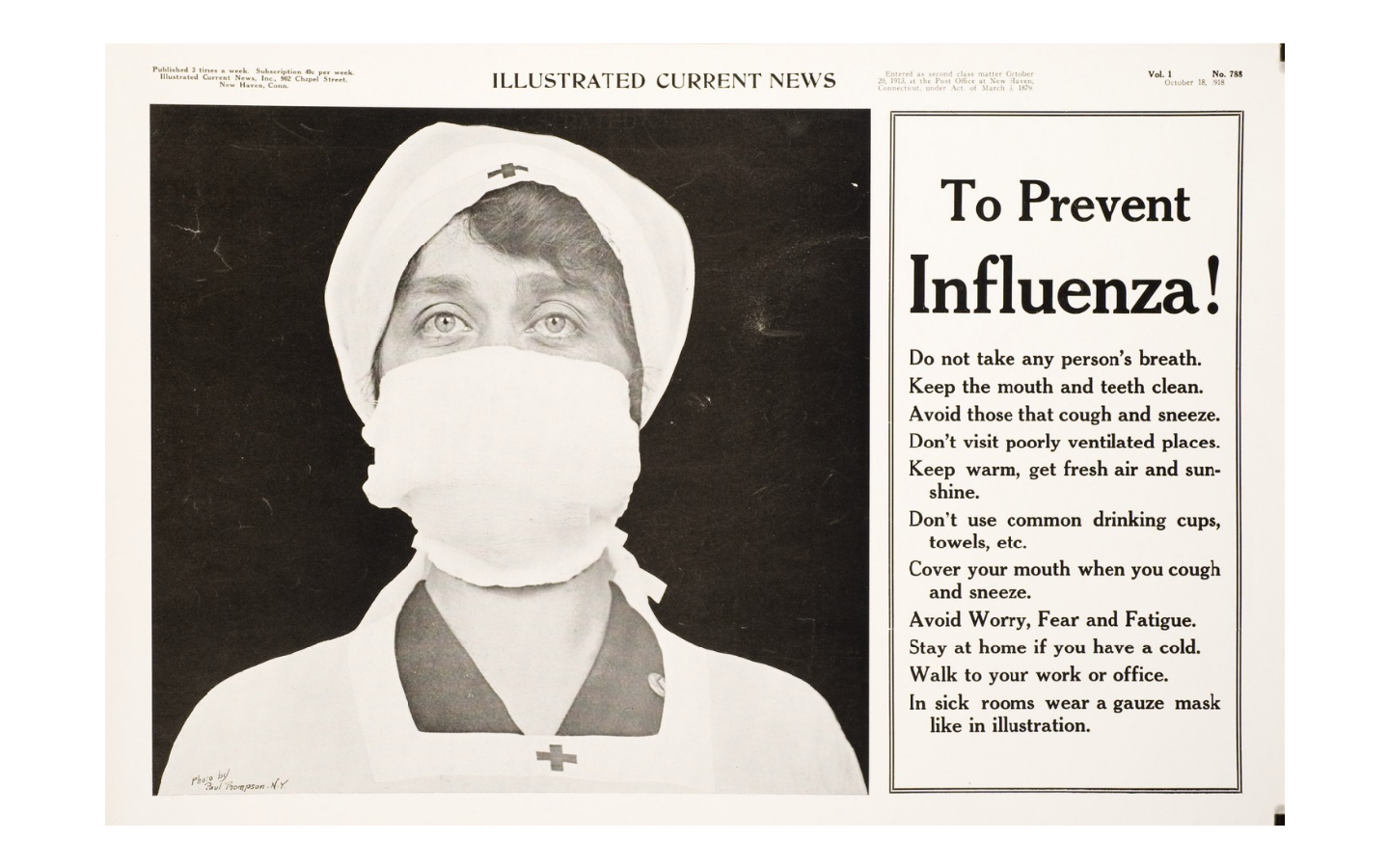
Illustrated Current News, 1918. Courtesy National Library of Medicine, US.
As the fight against COVID-19 carries on, I continue to see links with the Spanish flu pandemic, and increasingly with wartime itself. Some of you will know that while The Cowkeeper’s Wish tells the story of our maternal side, including the WW1 period, our first book together, The Occupied Garden, tells the story of our father’s family in The Netherlands in WW2.
Recently my aunt wrote to our family group that she and a cousin had shared the feelings they were re-experiencing from war. They were little children then, but wise enough to sense the fear and the tension that came from not knowing what would happen next. “Several times [lately] I have thought of our parents,” she wrote to my dad and her other siblings. “Mom in 1940 with three little ones and pregnant with a fourth. And now I understand more than ever Dad not willing to give up his radio [though forbidden by the occupiers], each day hoping to gain some knowledge about their near future.”
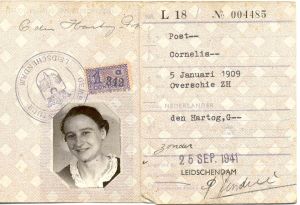
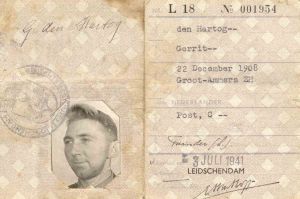
Cor and Gerrit den Hartog’s identity cards from WW2.
For people living under occupation, radios were a lifeline to the world outside, and to hopeful news about defeating the enemy. Can you imagine the times we are living through now, and how we would feel if we didn’t have radio or the internet or news of our progress in battling the virus? Much of the news is bleak, of course, and worse yet, false, so we need to be as careful consuming it as we are about washing our hands.
Last week Health Canada issued a warning about “drugs, natural health products, homeopathic products and medical devices … that make false or misleading claims to prevent, treat or cure COVID-19.” Dubious advice includes everything from drinking cow urine or bleach to consuming Chaga mushrooms and Vitamin C. The World Health Organization’s myth-busters page tells us “No. Spraying alcohol or chlorine all over your body will not kill viruses that have already entered your body.” And also states that “Garlic is a healthy food that may have some antimicrobial properties. However, there is no evidence from the current outbreak that eating garlic has protected people from the new coronavirus.” And while a bubble bath is a lovely way to relax and calm your nerves in troubled times — and also to get clean! — “Taking a hot bath will not prevent you from catching COVID-19.”
Revisiting 1918 via the newspaper archives, I see that plenty of ads turn up promising influenza cures. There was Dr. Chase’s Menthol Bag, which you pinned to the chest of your underclothes. “The heat from the body causes the menthol fumes to rise and mingle with the air you breathe, thereby killing the germs and protecting you against Spanish influenza and all infectious diseases.” Dr. Chase also offered “Nerve Food” to strengthen the heart, as well as Syrup of Linseed and Turpentine for the throat and bronchial tubes.
And there were Evans’ Pastilles, “made from a private formula … and free from poisonous alkaloids.” The ads warned that the flu thrived in heated, crowded theatres, but “the ill-effects of the germ attacks can be neutralised if one or two Evans’ Pastilles are allowed to dissolve in the mouth when the danger threatens.” Likewise there were “dainty white tablets” called Formamints, so harmless that “children and infants can take them freely,” and yet so powerful that they “destroy the most harmful bacteria that can menace life.”
“Sucking Formamint tablets, you hardly realize that you are disinfecting your mouth and throat with one of the most powerful germicides known to Science. All you are aware of is a faintly acidulated sweetness, cleaning and moistening the membranes, allaying thirst, refreshing the vocal organs, and purifying the breath without scenting it.”
A writer in the Whitby Gazette reported hearing from a distinguished London doctor that “a raw onion in a fever-stricken room soon decays, because it attracts the germs.” Another writer boasted in the Hamilton Advertiser that he ate a steady diet of onions, and “did not get the ‘flue’ in the recent epidemic; but,” he admitted, “there are others who
The Globe, October 1918
neither had onions nor the Spanish influenza.” A reader wrote in to the Coventry Telegraph, advising everyone to “eat two small onions, uncooked, every night, as a fine preventive. The efficacy of an onion is too well-known to need much persuasion.”
Interviewed years after her WW1 service, the Canadian nurse Mabel Lucas recalled her younger sister falling ill with influenza. Mabel was still overseas, and relieved that one of her old classmates had offered to care for the girl. “When she found out that they said there was no hope for her, she said ‘Can I do what I want to do?’ The doctor said, ‘Anything that you think will help.’ She made onion poultices and put them on [my sister’s] back and chest and even on the bottom of her feet. She kept them on for days. When I came home and would give her a bath, I could still smell onions. It was right in the pores. … She lived for years afterwards.'”
So, she survived the wars — both the First World War and the war against influenza.
In our family email group, perhaps inspired by my aunt’s reawakened memories of wartime Holland, my cousin made an interesting analogy regarding “Us Against COVID-19.” There are the people she calls “unseen heroes” — ordinary people who shop for friends and strangers in quarantine, or make food for others working long and extra stressful hours, or come up with ingenious ways to battle the enemy. And there are the collaborators, the people who refuse to stay in self-isolation or quarantine, who lie about where they’ve been or what their symptoms are, or who buy up large amounts of supplies: toilet paper, wipes, hand sanitizer, masks and gloves, with a plan to resell them online for a profit.
Then of course there are the resistance fighters: the healthcare workers and the truck drivers and the grocery store employees and the cleaners; the firefighters and the police and the postal workers; the gas station employees and the farmers and the staff at longterm care homes. The list goes on and on for the people who are on the front lines in varying ways, potentially exposing themselves to the virus every day, but providing essential services for the rest of us.
♥
Sources:
British Newspaper Archive
National Library of Medicine
Globe & Mail Historical Newspaper Archive, Toronto Public Library
People are social animals. Generally, we like to be together, and whether that means sitting quietly with one person or moving through a street filled with many, self-isolation and quarantine and social distancing are difficult things for most of us to do. In an effort to combat the unnatural feel of being without the casual contact of our fellow man, people all over the world have been bridging the gap in creative ways. Famous musicians, comedians and artists, self-isolating like everyone else, have shared livestream performances from their living rooms. Ordinary people, practicing social distancing, have sung from balconies in Montreal, Edmonton and New York, and applauded from windowsills in European cities in tribute to healthcare workers. In Scotland, mothers organized the I Spy a Rainbow movement that has housebound children pasting artwork in windows to uplift spirits. All these efforts show how much people need to feel a part of a community, and how they want to contribute something of value in a time of crisis.
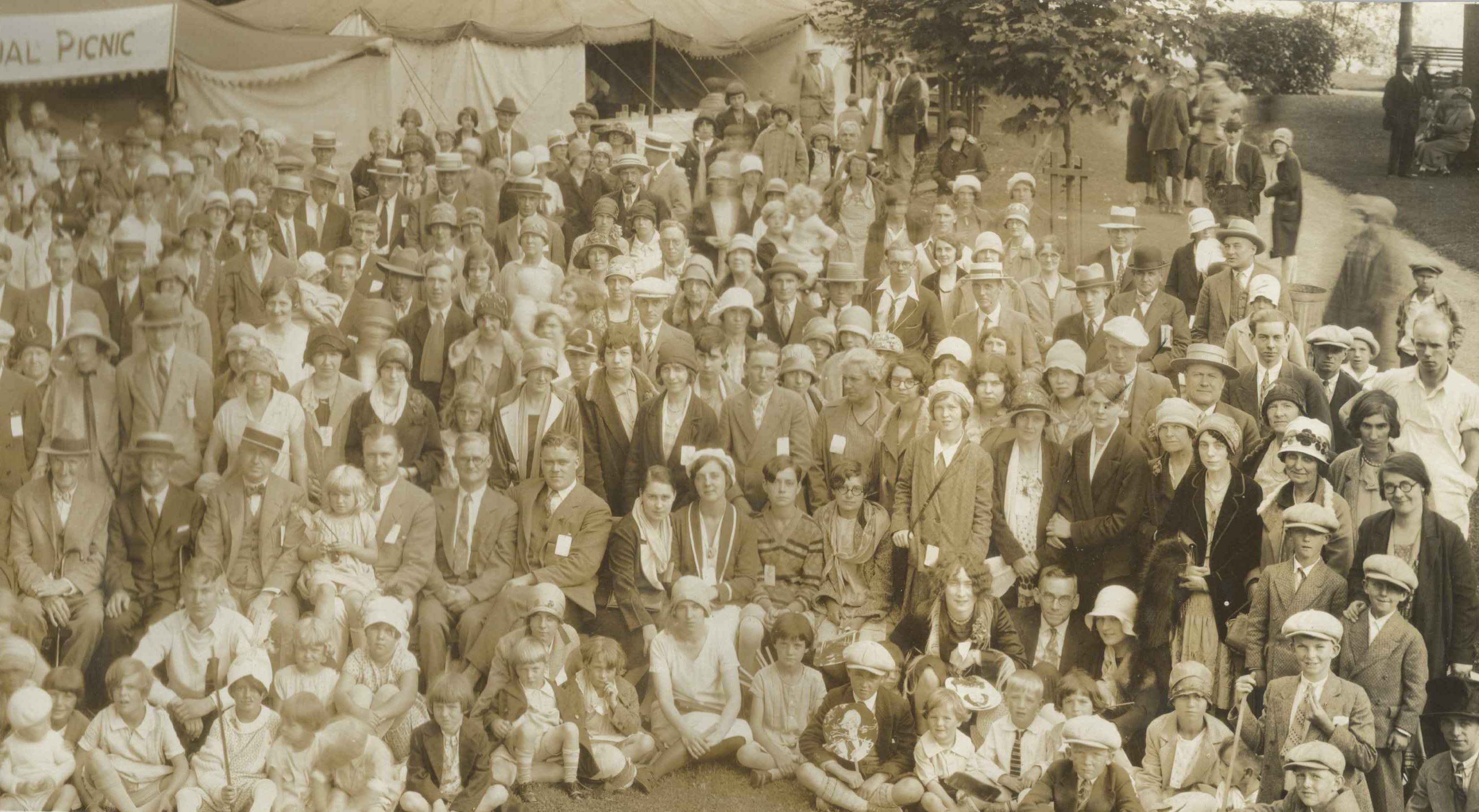
McCormick’s Annual Picnic in London, Ontario, 1929. No social distancing here.
Recently a request circulated in the community where I live, generated by our small hospital, asking for anyone with sewing skills and material at hand to make face masks for use by healthcare workers. A pattern was shared, and has done the rounds via social media and emails. Elsewhere, similar efforts are ongoing. My sister wrote from Toronto about a friend who has turned her talents as a seamstress (she owns a yoga clothing company called Dear Lil’ Devas) to making masks. My other sister wrote from Peterborough about a woman she knows who works from home as an energy and sustainability analyst for architects and building planners, but who has broken out the needle and thread and started stitching face masks.
People everywhere, it seems, want to do something useful. It was not much different in 1918, when Spanish flu ravaged a world already on its knees after years of war and conflict. The Red Cross on both sides of the Atlantic encouraged the sewing of homemade masks, and a newspaper in California declared them “absolutely necessary to safeguard citizens against the further spread of the epidemic.” In Boston, the commissioner of health urged citizens to “make any kind of mask, any kind of covering for the nose and mouth and use it immediately and at all times,” and that city’s Daily Globe newspaper shared instructions on the making of gauze masks. In England, the Evening Telegraph and Post reported that the Red Cross Society was “busy making anti-influenza masks to cover the mouth and nostrils.” They were for the use of soldiers “returning to the Colonies [and would be] worn on the voyage.” Here in Canada, the Alberta government made wearing masks in public compulsory, while in Regina, Saskatchewan, where the masks were not mandatory, a person could be fined for coughing, sneezing or spitting in public.
Red Cross nurses sorting homemade face masks. Photo courtesy National Archives, Washington
Not everyone thought the masks a good idea. In San Francisco, a dispute over masks turned violent when Henry Miller, a deputy health officer, shot a horse-shoer named James Wisser in front of a drug store when he refused to don a face mask. Wisser was taken to hospital with a gunshot wound to his leg and there placed under arrest for failing to obey Miller’s order.
In Canada, opinion was also divided, with some provinces making face mask use mandatory and others not. Lloydminster, a municipality straddling the border of Alberta and Saskatchewan, had the unique dilemma of two opposing laws in effect in the same town. As the Edmonton Journal reported, “when a number of the citizens of Lloydminster, Sask., crossed the street and came into Lloydminster, Alberta without masks, they were summoned to court. Despite the fact that they claimed only to have strolled over for casual errands of business or pleasure, they were fined for violating the law, and went back to their own side of the street in indignation.”
Nor could the medical community agree on who should use a face mask. Dr. Thomas Whitelaw, Medical Officer of Health for Edmonton, wrote in the December 1919 issue of the Canadian Medical Association Journal that even after the Alberta government ordered everyone to wear a mask outside their homes, the number of cases continued to increase, and, he alleged, “public confidence in it as a prevention soon gave place to ridicule.”
Calgary Herald, November 1918 “Why should I be forced to be so uncomfortable?”
Dr. Henry Bracken, Secretary of the Minnesota State Board of Health, encouraged the wearing of masks by the public, and the Board issued instruction for the use of the masks. “The outside of a face mask is marked with a black thread woven into it. Always wear this side away from the face. Wear the mask to cover the nose and the mouth, tying two tapes around the head above the ears. Tie the other tapes rather tightly around the neck. Never wear the mask of another person. When the mask is removed … it should be carefully folded with the inside folded in, immediately boiled and disinfected. When the mask is removed by one seeking to protect himself from the influenza it should be folded with the inside folded out and boiled ten minutes. Persons considerably exposed to the disease should boil their masks at least once a day.” Despite this advocacy, though, Dr. Bracken himself chose not to wear one, saying “I personally prefer to take my chances.”
So are the homemade masks a good idea? One hundred plus years after the debates of 1918, opinion remains divided. Now, as then, there will be those who feel as Dr. Bracken did, and who will make the choice to go without. At the same time, people will come together, however virtually, to share their face mask patterns and know-how, to join in song or tell a story or draw a picture. And at the end of the day, we can take heart from the caption written on a Scottish child’s rainbow drawing: smiles are contagious.
I’m sure everyone has stepped up contact with family members in the last while. We’ve been hearing from my husband’s relatives in the UK and in other parts of Ontario, and from my family too, here in Canada and in the Netherlands. Several of the notes that have come have mentioned nature, and how birds are singing and geese are honking, oblivious to the turmoil. A good friend who lives in Manchester tells me she has been working in her garden, and it made me realize how anxious I am for spring, because digging in the earth and helping things grow is such a soothing pastime. (And this morning I read a beautiful essay reminding me that even when the television is “full of terror … the trees are full of music.”)
My father and his wife are in Guatemala right now, on their sailboat. They live aboard, traveling the world, and made it into the country just before its borders closed. “Today was the first day of the curfew starting at 4 p.m.,” my dad wrote yesterday to our wider family group, “and although a busy high bridge towers over the Rio Dulce not far away and we are surrounded by marinas, not a thing is moving on land or on the water except the odd toucan, a pair of parakeets and assorted other birds. It is eerily quiet.”
Dad suggested a group of us — aunts and uncles, cousins, siblings — check in with each other every couple of days, since we are a far-flung lot. My mom and her husband are in Portugal, due home Friday, and we have all been eagerly anticipating their safe return. This morning she wrote to the group, “We are anxious to get back home to all the snow, which is the reason we leave in the winter!! Everything is in lockdown here and has been for about a week. First of all the schools and universities all closed, then the store, bars, restaurants. Some outdoor patios stayed open for a few days as long as people sat far apart, but now everything is closed. They are being very strict about it. Grocery stores are open but fewer people are there. There are big signs everywhere warning people to keep a distance and to look at the products and choose only what you want, and buy only what you need. Do not handle things. There are no attendants at the deli counter, only packaged things to choose from. There are big plexiglass screens shielding the cashiers and only cards are accepted, no cash. There are red signs on the floor for cash lineups showing how far apart you must be. Pharmacies will only let one or two people in at a time. When one person goes out, one can go in. In the lineup outside people are 2 metres apart. The post office is like that too. There are only 6 apartments occupied in our hotel now and when we go out to get groceries we have to ring to be let in. We cannot stay in the room when the maid comes. She is wearing a mask and we have go out until she is finished.”
Even though I’m in my 50s now, I’m used to my parents worrying about me. It’s weird to have the tables turned. But the emails help. And in our day and age we’re lucky enough to have facetime too. My teenage daughter can still hang out with her friends this way. All of this brings to mind how essential letters must have been a century ago for people separated by war, though the missives had to float slowly back and forth across the ocean, and sometimes all kinds of things had changed by the time the letters got read. When the influenza pandemic began in 1918, new worries piled on to the worries that had already existed for years. Snooping through the wonderful Canadian Letters & Images Project, I found a treasure trove of photos and letters connected to a soldier named Cecil Moody, who enlisted in 1915 and served with a Field Ambulance unit until the end of the war. He had a wife he called Budsie back home in Canada, and a little boy nicknamed Bobs. The collection contains almost 40 letters, but the one below is especially touching, and gives a glimpse into how the flu pandemic impacted medical workers’ already challenging duties.
♦
Les Fermont, South of Arras, June 29, 1918
Budsie Dear:
Budsie & Bobs, courtesy Canadian Letters & Images Project
Although you let a week slip by without writing, I can fully forgive you for the dandy snaps you sent. I was ever so pleased with them girlie. Isn’t wee Bobs getting to be a big boy. Lord! He will be as big as his Dad if I don’t soon get home. And you are looking to sweet for words Dearie. The boys that I have showed the picture to all say what a peach of a looking girl you are. And really Hon. I am so wonderfully proud of you when anybody pays you a compliment; it always makes me feel as though it had been paid to myself.
You’re some little tailoress too Budsie. Bob’s clothes look awfully cute. You must feel jolly proud of yourself, turning the wee chap out so smartly.
Well, you will notice that I too have missed a week in writing, but my excuse is good, and an honest one. Our ambulance base covered more miles in the last two weeks than they have since we have been in France. We have had three or four moves in the last two weeks, but apart from that, we have been running day and night, hauling Spanish Flu patients. I guess you have read in the papers about the influenza plague. Well, we are certainly getting our share of it in France now. Harry has been in the Hospital for the last two or three days, but he is OK again. Now, it’s nothing really serious, but by gosh, a man is almighty sick for a couple of days. I think Fritz’s army is also suffering from the plague from the reports of the prisoners taken lately. In fact, it is rumoured that that was the reason their offensive was given up. …
An advance dressing station in France, 1916, courtesy Canadian Letters & Images Project.
Well Hon, we are back in the line again after the longest rest our division has had since we have been in France. We all have to break ourselves in again, but we are on a very quiet front, so unless something starts up, we shall have a very “cushy” time. In the last 13 days, our old bus has travelled just over 1300 miles! Most of the rips have been short ones, but numerous. … We have been sleeping in our cars for a long time, but we don’t like to take chances now that we are hauling so many flu patients. I think that is how Harry caught it.
A watercolour by one of Cecil’s fellow soldiers in France. Courtesy Canadian Letters & Images Project.
… No, I’m afraid there is slim chance of my ever getting back to you Darling, until this damn war finishes up. How I would love to be with you again. But I couldn’t bear to come home for for a couple of months and then have to leave you again. I would much rather wait until I can have you again for “Keeps”.
Poor old Harry. If there’s ever any sickness going around, it always seems to attach itself to him. His chances of returning to Canada seem pretty slim now. He has not heard anymore.
Buds, why don’t you write a little letter to me from Bobs. You have never even mentioned whether he has received any of the little notes I have enclosed in your letters. You can ask him what he wants to say and write it for him. Don’t suggest anything – just see what he would say on his own accord. Where did he get the wee tricycle? Can he ride it alright? …
Well old sweetheart, I must say Au Revoir. If you miss one week in writing Dear, make the next letter twice as long. I love to get your letters so much. Have you noticed any of my letters missing? I still number them. All my love to you precious girl, and a big kiss. Love too to Bobs.
Ever your own
Cis
Cecil Moody, courtesy Canadian Letters & Images Project